
HVAC FEASIBILITY Software
Make Confident Early-stage HVAC Concept Decisions
Move HVAC feasibility and concept modelling from Excel into one simulation-driven workflow — using building simulation and energy data to guide system choices early.
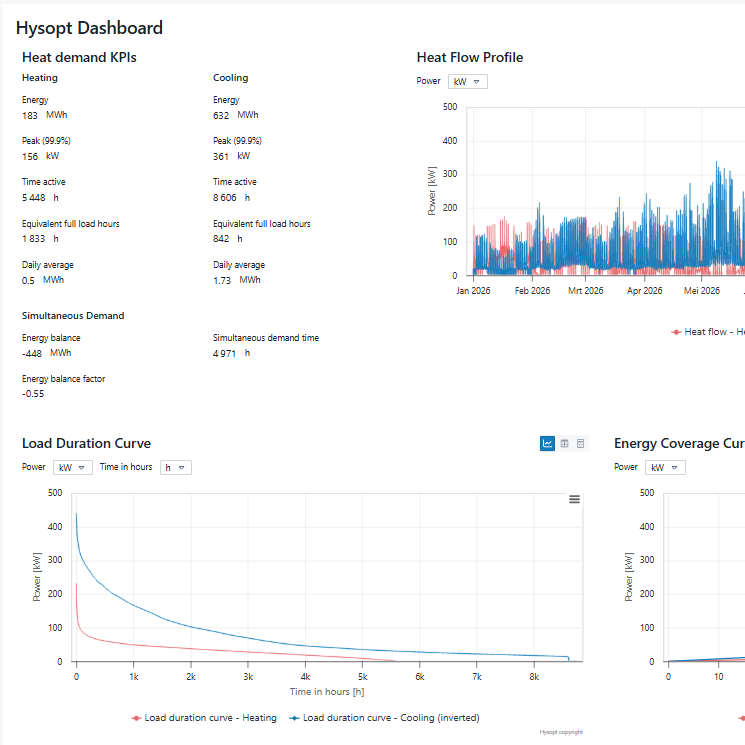
Replace Excel-based feasibility with simulation-driven analysis
Early-stage HVAC feasibility often relies on spreadsheets that are hard to validate and even harder to compare. By bringing feasibility and concept analysis into a simulation-driven environment, you can explore options faster and base decisions on consistent results.
- Analyse early-stage energy performance and demand profiles directly in Hysopt, without relying on spreadsheet-based calculations.
- Compare HVAC system concepts and plant approaches side by side before committing to detailed design decisions.
- Use KPI visualisation—energy use, CO₂ and cost indicators—to confidently support feasibility discussions and concept choices.
Want to move beyond spreadsheet-based feasibility analysis?
Reuse building simulation and energy data without rework
Early-stage feasibility shouldn’t start from scratch. By reusing existing building simulation outputs and measured energy data, you can avoid manual rework and focus directly on evaluating HVAC system concepts and plant strategies.
- Import building simulation outputs and measured energy data directly into Hysopt to avoid manual reformatting or data loss.
- Simplify early-stage HVAC modelling by representing building demand with equivalent end units instead of fully detailed secondary systems.
- Focus faster on HVAC plant selection and system concepts by starting from reliable demand profiles rather than rebuilding models from scratch.
Reuse existing building simulation and energy data in your feasibility studies.


Compare early-stage HVAC scenarios before committing to design
Before detailed design begins, it’s critical to understand how different HVAC concepts perform under real demand conditions. Comparing scenarios early helps clarify trade-offs and align stakeholders around the right system approach from the start.
- Explore and compare multiple HVAC system concepts and plant configurations early to understand their impact on energy performance and feasibility.
- Assess trade-offs between efficiency, cost and system complexity at concept level, before detailed sizing or engineering starts.
- Use consistent simulation results to align engineers, consultants and stakeholders around early-stage system decisions.
Ready to evaluate HVAC concepts before moving into detailed design?
Make better early-stage HVAC decisions
Use the Hysopt simulation dashboard to analyse feasibility, compare HVAC concepts, and guide system choices before detailed design begins.
Frequently asked questions
What is HVAC feasibility analysis?
When should HVAC feasibility be performed in a project?
How does this differ from detailed HVAC design and simulation?
Can I reuse building simulation or energy data for HVAC feasibility?
Why replace Excel for HVAC feasibility studies?
Uncover insights, success stories, and expert strategies




.png)
.png)