A Practical Guide to Heat Pumps for Domestic Hot Water
A heat pump’s rated output is only the starting point. Learn how to assess DHW charging temperatures, storage recovery, booster arrangements and shared plant controls.

A heat pump’s rated output is only the starting point. Learn how to assess DHW charging temperatures, storage recovery, booster arrangements and shared plant controls.
Heat pump domestic hot water (DHW) design brings together demand, charging temperature, available heat output, storage and controls. Hysopt helps engineers model these interactions, including DHW storage and booster heat-pump arrangements, so they can compare proposed systems before selecting equipment.
Replacing a boiler with a heat pump changes the DHW design problem. In a building with shared plant, you need to establish whether the proposed system can recharge the hot water store while meeting the building’s other heating demands.
The answer depends on the charging conditions, storage and control sequence.
Explore Hysopt’s domestic hot water design and simulation workflow.
For an existing building, establish actual demand as far as the available evidence allows. The installed boiler capacity can be a poor guide to the heat pump requirement, particularly where earlier selections included generous allowances.
For a new system, document occupancy assumptions, expected draw-off patterns and the basis for peak demand. Then identify what the heat source must supply:
Set the storage, distribution and outlet temperature requirements from the project’s water-hygiene and scald-prevention strategy before comparing energy performance.
Keep those requirements consistent between options. A comparison has little value if one concept quietly assumes more storage, a shorter peak or a different service temperature.
Heat pump output belongs to a set of operating conditions. Check the manufacturer’s performance data at the source temperatures and delivery temperatures relevant to the DHW duty.
A capacity stated for low-temperature space heating does not establish the available output during cylinder charging. The charging circuit may also need to operate above the required stored-water temperature to transfer heat through the coil or heat exchanger.
Three questions help expose weak assumptions:
Temperature lift matters here. Raising the delivery temperature or lowering the source temperature generally reduces the coefficient of performance (COP), the ratio of heat output to electrical input. The size of that change depends on the equipment and operating point.
For air-source systems, ask how the supplied capacity data accounts for defrost. Keep that answer visible in the design assumptions.
Several arrangements can serve the same building. Each places different demands on the heat source, storage and controls.
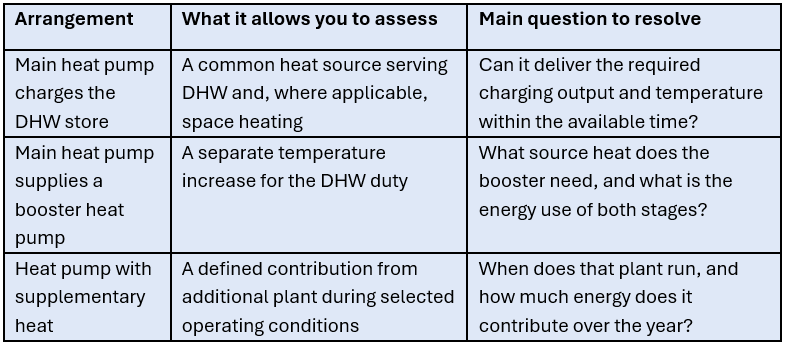
Choose against the actual duty and project constraints. Electrical capacity, plant space, available source heat and the role of existing equipment can change the decision.
Hysopt’s documented DHW templates include a ground-source heat pump feeding a booster arrangement. Its wider heating library also includes heat pump and boiler configurations. These provide starting points for building and comparing the proposed system.
A booster heat pump needs a heat supply on its evaporator side. That load must appear in the upstream design.
Consider an illustrative booster delivering 60 kW of heat at a heating COP of 3:
This simplified steady-state balance excludes external pump and auxiliary loads.
If the main heat pump provides that 40 kW, its electrical consumption also belongs in the comparison. A good COP for the booster alone cannot establish the efficiency of the complete arrangement.
Check that the source circuit can supply the required heat and flow at the assumed temperatures throughout charging. Otherwise, the booster calculation starts from conditions the upstream system cannot maintain.
The DHW store gives the heat pump time to generate heat outside the immediate draw-off peak. Whether it succeeds depends on the usable stored energy and the rate at which the system can recharge it.
Nominal cylinder volume is only one input. Stratification, connection positions and sensor locations, together with the charging sequence, influence how the store responds.
Write down the proposed controls early:
A priority setting is a design decision. If DHW takes priority, assess the duration and effect of the interruption elsewhere. If both demands run together, check the plant output and hydraulic conditions during that overlap.
See how Hysopt connects DHW storage, heat sources and controls.
The design-day check remains necessary. The annual result also depends on charging schedules, changing source conditions, low-demand operation and how often supplementary heat runs.
Build a comparison around outputs the client can use: electricity and fuel consumption, predicted operating costs, CO₂ emissions, charging behaviour and the contribution of each heat source.
Hysopt uses COP and power tables to represent heat-pump behaviour. With appropriate equipment data, demand profiles and controls, engineers can use Hysopt Simulator to compare how different configurations behave over time.
Test a busy morning, recovery between peaks and periods of low demand. For shared plant, include simultaneous heating and DHW operation where the control strategy permits it.
A useful design review should explain why the preferred arrangement fits the project and which assumptions most affect that decision. That gives the client something more useful than a single efficiency figure.
Working out how to combine hot water demand, storage and heat pumps?
Explore Hysopt’s DHW design and simulation workflow, then use the enquiry form to discuss the design decisions you need to assess.
Discover the key trends transforming HVAC design across buildings, data centres and district energy networks.
From AI-driven engineering and grid constraints to system flexibility and verified performance, explore what’s changing, why it matters and how to prepare.

Use Hysopt to simulate hydronic systems, compare design scenarios and reduce oversizing risk.