How to Size DHW Storage for Peak Demand and Recovery
A practical method for balancing DHW storage, charging power and recovery, with a worked energy example and the checks needed before selecting a cylinder.

A practical method for balancing DHW storage, charging power and recovery, with a worked energy example and the checks needed before selecting a cylinder.
Domestic hot water (DHW) storage sizing means matching usable stored energy and available heating power to the timing of hot-water demand. The system must meet the peak and recover before the next one. Hysopt can model DHW storage, draw-off profiles and controls to help engineers compare selected storage volumes and charging strategies.
A cylinder volume is only one part of that decision. Start with the duty it needs to deliver.
A DHW cylinder stores potable hot water. A primary buffer vessel stores heating-system water, with heat transferred to domestic water through a heat exchanger.
These arrangements need different calculations. A primary buffer can contain substantial energy while its temperature is too low to deliver the required DHW outlet temperature through the selected exchanger.
For an indirect cylinder, also establish the coil or external exchanger performance. The heat source, heat-transfer equipment and vessel must work together.
Daily consumption helps estimate energy use. Storage selection needs a timeline: how much water is drawn, at what temperature, over which period, and how soon the next demand arrives.
Caleffi’s storage-sizing guidance identifies peak consumption, peak duration, preheating time and water temperatures as key inputs.
Record these assumptions before selecting equipment:
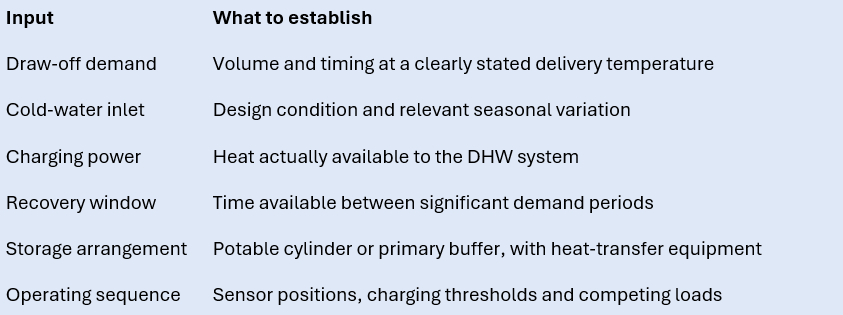
Keep volumes on a consistent temperature basis. Litres delivered at a mixed outlet temperature cannot be compared directly with litres stored at a higher temperature.
For wider design questions, Hysopt’s domestic hot water design and simulation software brings demand, storage and connected heating equipment into the same engineering workflow.
Consider an illustrative demand of 1,000 litres over 30 minutes, requiring a 35 K temperature rise from the incoming water. These are calculation assumptions, not recommended operating temperatures.
Using approximately 1.163 Wh per litre per kelvin:
Draw-off energy = 1,000 × 35 × 1.163 ÷ 1,000 = 40.7 kWh
Assume 30 kW of heat reaches the DHW duty continuously throughout the peak:
Concurrent heat input = 30 × 0.5 = 15 kWh
The minimum energy contribution from storage is therefore:
40.7 − 15 = 25.7 kWh
This first calculation excludes losses, start-up delays and delivery constraints. It establishes the energy deficit, not the final vessel size.
Now spread the same demand uniformly across one hour. The 30 kW source contributes 30 kWh, reducing the deficit to 10.7 kWh. The water volume has not changed; the storage duty has.
For a changing demand profile, calculate the balance over successive time intervals. Follow the store’s state of charge, including periods of replenishment, and identify its greatest depletion.
A heat-source nameplate does not establish how quickly the cylinder will recover.
Check the manufacturer’s output at the proposed operating conditions, together with the coil or exchanger performance and primary flow. For an indirect store, Hysopt uses the heat exchanger’s UA value, its overall heat-transfer coefficient multiplied by area, to represent heat transfer into the store.
Also establish whether DHW receives the source’s full output. A shared plant may serve space heating, charge another store or wait for a control condition.
Use the power delivered to the DHW duty in the calculation. Avoid counting capacity that the actual operating sequence cannot make available.
Usable storage is the energy that can be delivered while meeting the specified service conditions. It is not automatically the energy represented by the vessel’s full nominal volume.
Stratification matters because the temperature at the outlet can differ from the vessel’s average temperature. Mixing and heat transfer between layers change that distribution during charging and draw-off.
For a potable cylinder, assess the usable draw-off volume at the required delivery temperature. For a primary buffer, assess the temperature range over which the exchanger can still deliver the required DHW duty.
Review candidate sizes against their geometry, connections and initial temperature distribution. Hysopt’s thermal storage model represents vertical temperature layers, losses and measurement positions.
Keep the project’s water-hygiene and service-temperature requirements fixed when comparing candidate sizes.
The first peak can pass while the second fails.
Return to the illustrative 25.7 kWh depletion. After the peak, assume the source continues delivering 30 kW, while ongoing demand and losses consume 10 kW.
Net recovery power is 20 kW, giving:
Recovery time = 25.7 ÷ 20 = 1.29 hours, approximately 77 minutes
That estimate assumes constant available power and successful heat transfer throughout recovery. A temperature-dependent charging rate requires a time-based calculation.
Compare the result with the actual interval before the next peak. Then repeat the sequence over the relevant operating day. Starting every simulation with a fully charged store can hide progressive depletion.
If recovery is insufficient, compare changes to charging power, timing, usable storage or demand assumptions. Increasing cylinder volume alone does not create additional daily heat input.
Write down what starts charging, what stops it and which sensor makes each decision.
Then test the awkward operating cases: a peak beginning just before charging starts, continued draw-off during recovery, and concurrent space-heating demand.
Hysopt’s documented DHW templates include shared heating and DHW systems, demand-dependent boiler temperature control, and heat-pump booster arrangements. These provide starting configurations for comparing operating strategies.
Use DHW system simulation to compare candidate volumes and controls against the same demand assumptions. Review temperature traces, charging periods and the condition of the store before each peak.
The design record should explain why the selected combination works, with its assumptions and operating limits visible.
Need to compare storage capacity, charging power or control options? Explore Hysopt’s DHW workflow and use the enquiry form to discuss the design you are working on.
Discover the key trends transforming HVAC design across buildings, data centres and district energy networks.
From AI-driven engineering and grid constraints to system flexibility and verified performance, explore what’s changing, why it matters and how to prepare.

Use Hysopt to simulate hydronic systems, compare design scenarios and reduce oversizing risk.